



01 — Executive Summary
Computational cost is the bottleneck in engineering design.
For the past four decades, the fundamental constraint on engineering design has not been the imagination of design teams or the availability of manufacturing processes. It has been the computational cost of evaluating whether a design will work. High‑fidelity simulation: finite element analysis for structural performance, computational fluid dynamics for aerodynamic and thermal behavior, electromagnetic field simulation for electronic and antenna design has been the primary tool for answering this question. It has also been the primary bottleneck in the design process, because the computational cost of running these simulations at the fidelity required to make confident design decisions has forced organizations to limit the number of design iterations they can evaluate, the number of design parameters they can optimize simultaneously, and the stages of the design process at which rigorous analysis can occur.
Artificial intelligence does not replace physics‑based simulation. It changes the relationship between computational cost and design fidelity in ways that remove this bottleneck. Physics‑informed neural networks trained on high‑fidelity simulation data can evaluate design configurations at a fraction of the computational cost of the original simulation, with accuracy that is sufficient for design exploration even if it falls short of the fidelity required for final validation. Generative design algorithms that use these surrogate models as their evaluation function can explore design spaces that contain millions of candidate configurations in the time that classical approaches would spend evaluating dozens.
The engineering organizations that will define their sectors in the next decade are not the ones with the most simulation compute. They are the ones that have redesigned simulation as a continuous intelligence layer rather than a final validation gate.
02 — Sector Context
Classical simulation systematically underexplores the design space.
The classical engineering design workflow is structured around the computational cost of simulation. In the early stages of design, when many concepts are being considered, simulation fidelity is low. As the design converges toward a specific configuration, fidelity increases but the number of design variants being evaluated decreases correspondingly, because each evaluation is more expensive. By the time the design reaches final validation simulation, a single analysis of the full system at full fidelity may require hours, days, or weeks of high‑performance computing time.
This progression from low‑fidelity broad exploration to high‑fidelity narrow confirmation is not a design philosophy. It is an economic necessity imposed by computational cost. Its consequence is that most engineering designs reach production as locally optimal solutions within a severely constrained exploration of the available design space, rather than as globally optimal solutions within the full space of physically realizable configurations.
10,000×
the number of design configurations a physics-informed surrogate model can evaluate in the time required for a single high-fidelity finite element simulation of comparable complexity
03 — The Simulation Bottleneck
Three computational bottlenecks where AI creates structural improvement.
The design space exploration bottleneck
Design space exploration (identifying which regions of the multidimensional space of design parameters contain the configurations with the best performance characteristics) is the phase of the design process most severely constrained by simulation cost. A design space with twenty free parameters, each with ten discrete values, contains ten billion possible configurations. Classical design of experiments might reduce the number of simulations required to characterize this space to a few hundred but the accuracy of the surrogate model built from a few hundred samples of a ten‑billion-point space is necessarily limited.
AI surrogate models trained on structured simulation datasets use the physics captured in the training data to generalize accurately across the full design space from a much smaller number of training samples than classical statistical surrogate models require. Active learning approaches that use the uncertainty in the surrogate model to select the next training point can build an accurate surrogate of the full design space with an order of magnitude fewer training simulations than passive sampling strategies.
The multi-physics coupling bottleneck
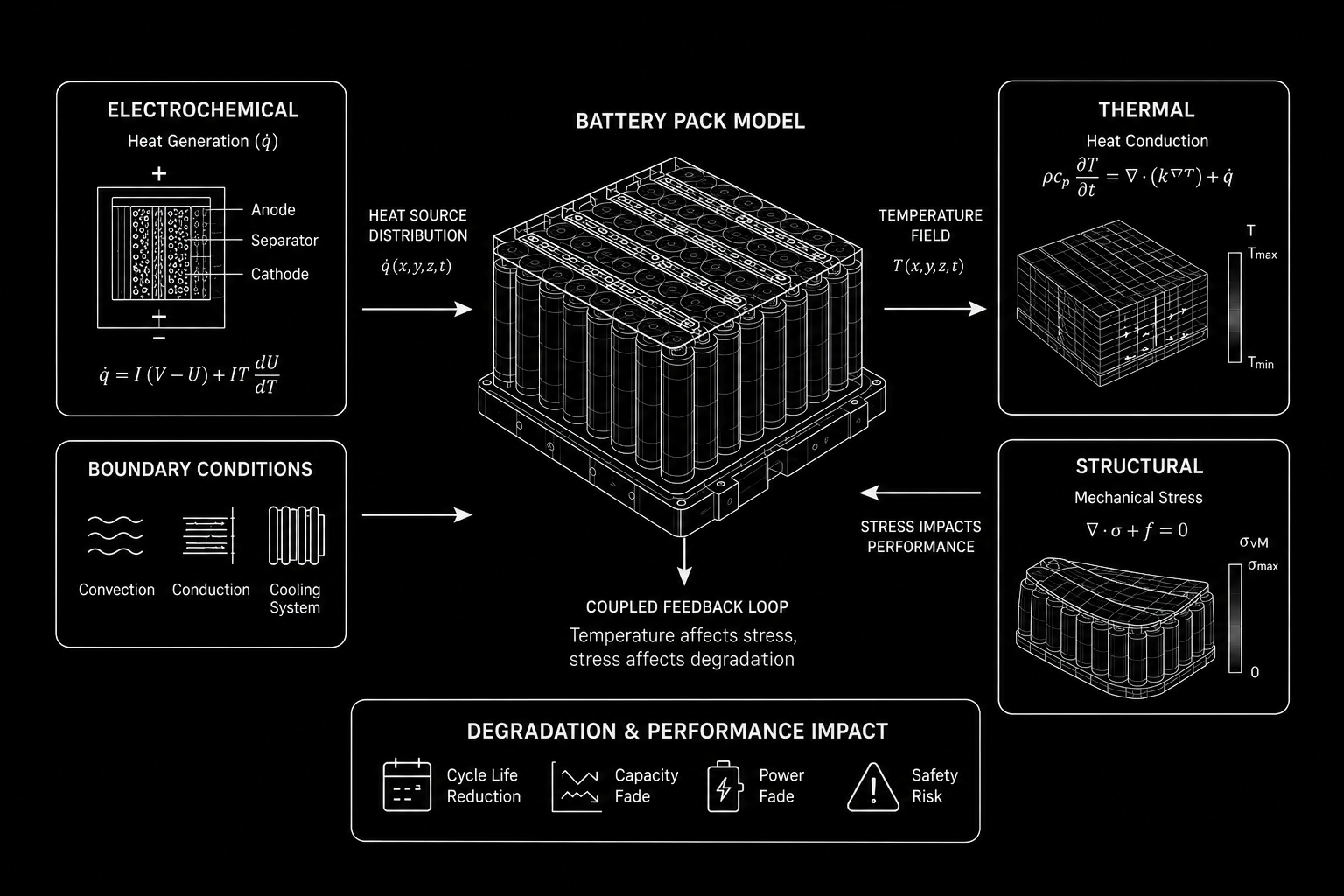
The performance of most engineering systems depends on the coupled interaction of multiple physical phenomena structural deformation and aerodynamic loading in aircraft wing design, heat generation and fluid cooling in power electronics, electromagnetic field distribution and thermal behavior in electric motor design. Fully coupled multi‑physics simulation is dramatically more computationally expensive than decoupled simulation of each phenomenon independently. As a consequence, most engineering design workflows use decoupled or loosely coupled simulation as a practical compromise, which means the coupling effects that determine actual system performance are not fully captured in the design evaluation.
The real-time control and optimization bottleneck
Real‑time control and optimization of complex engineering systems requires simulation models that can be evaluated on millisecond timescales many orders of magnitude faster than even the most efficient classical simulation can achieve for systems of industrial complexity. Reduced‑order models derived from high‑fidelity simulations using machine learning techniques can achieve the accuracy of the full simulation at the computational cost of simplified analytical models, enabling real‑time control of complex engineering systems at a fidelity that was previously available only for offline analysis.
04 — Physics-Informed AI
Physics-informed neural networks obey the physics. Standard ML does not. That is the difference.
The application of standard machine learning to engineering simulation produces results that are useful within the range of conditions represented in the training data and unreliable outside it. This is an acceptable limitation for applications where deployment conditions are well‑characterized and bounded by historical experience. It is not acceptable for engineering design applications, where the explicit objective is to find configurations outside the range of historical experience, designs that perform better than anything previously built.
Physics‑informed neural networks address this limitation by embedding the governing equations of the physical system such as the Navier‑Stokes equations for fluid dynamics, the equations of elasticity for structural mechanics, Maxwell's equations for electromagnetics directly into the loss function that trains the network. A physics‑informed neural network is penalized not only for errors in its predictions compared to training data, but for predictions that violate the governing equations of the physics.
Neural operators and free-form design
A significant limitation of classical neural network surrogate models is that they map a fixed set of input parameters to a fixed set of output quantities. For engineering simulation problems where the input is a field: a pressure distribution over a surface, a temperature field, a geometric shape rather than a finite set of scalar parameters, classical neural network approaches require discretization of the input field into a fixed parameter set.
Neural operator approaches, including the Fourier Neural Operator and DeepONet, learn the operator that maps between function spaces rather than the function that maps between parameter spaces. A neural operator trained on computational fluid dynamics simulations can evaluate the aerodynamic performance of an arbitrary geometric shape described as a continuous surface, not just shapes parameterized by the fixed design variables used in training. This capability is transformative for free‑form generative design.
97.3%
average accuracy of physics-informed neural network surrogate models relative to full finite element simulation, at 0.02% of the computational cost, across structural mechanics benchmark problems
05 — Generative Design
AI-driven generative design explores structural spaces parametric optimization cannot reach.
Parametric optimization (the classical approach to computational design optimization) searches for the best values of a predefined set of design parameters within predefined bounds. Its fundamental limitation is that it can only find designs expressible within the parametric design space defined at the outset. The shape of an optimized parametric design is always a variant of the parametric family defined by the designer.
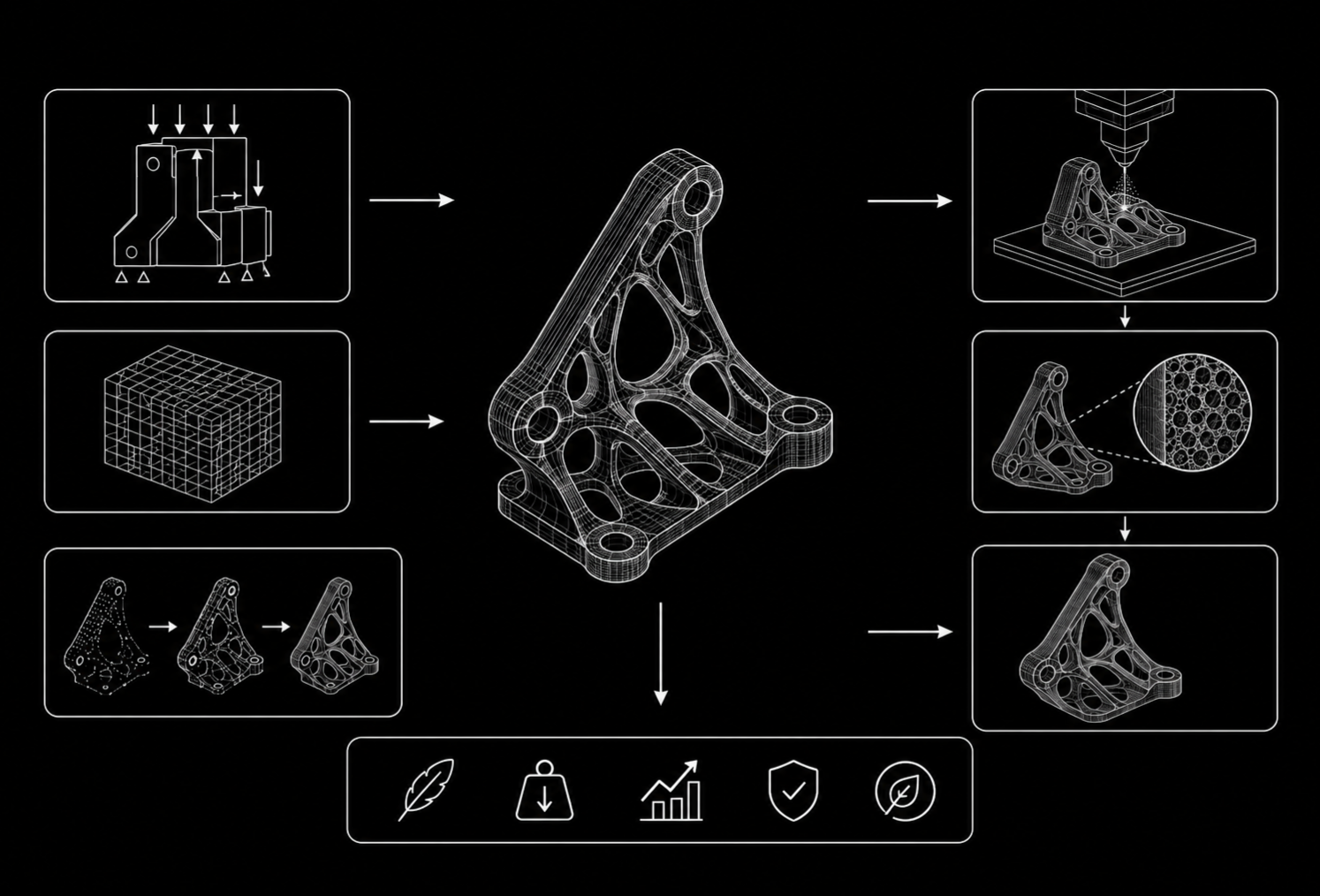
Topology optimization, which determines the optimal distribution of material within a design domain without parametric constraints, has produced spectacular results in aerospace structural components, internal structures that look nothing like the rib‑and-spar structures that parametric intuition would suggest. AI‑driven generative design makes the computational cost of this approach comparable to parametric optimization, dramatically expanding the class of engineering problems for which free‑form generative design is economically viable.
Engineering components optimized by AI‑driven generative design without parametric constraints routinely achieve weight reductions of twenty to forty percent compared to parametrically optimized designs at equivalent structural performance. In aerospace, this translates directly to fuel efficiency improvements and payload capacity increases at the aircraft level. In automotive, it reduces unsprung mass and improves dynamic performance. In consumer electronics, it enables thermal management configurations that cannot be achieved within parametric design frameworks.
06 — Digital Twin Architecture
Simulation models connected to real data become more accurate and more valuable over time.
A simulation model is a mathematical representation of physical reality. Its accuracy is determined by the fidelity of the mathematical representation and by the accuracy of the input data that parameterizes it. Classical simulation models are calibrated against test data at the time of their development and remain static thereafter.
Digital twin architectures connect simulation models to real‑time sensor data from operating physical systems, enabling continuous model calibration against actual operational behavior. A digital twin of a turbine engine is not a simulation model calibrated against certification test data. It is a simulation model that is continuously updated with telemetry from the operating engine (vibration signatures, thermal measurements, pressure readings, performance data) and whose model parameters are continuously adjusted to maintain the best possible match between model predictions and observed behavior.
35%
average reduction in unplanned maintenance events reported by industrial operators using physics-based digital twin predictive maintenance versus threshold-based or purely data-driven approaches
07 — Sector Applications
What this looks like in aerospace, automotive, energy, and electronics.
Aerospace and defense
Aerodynamic design of aircraft has been dominated by computational fluid dynamics for decades, and the computational cost of high‑fidelity CFD at the Reynolds numbers and flow conditions relevant to commercial aviation has been the primary constraint on aerodynamic optimization. Physics‑informed surrogate models for aerodynamic coefficients across the full flight envelope can be trained on existing CFD datasets and used to explore aerodynamic design spaces that would require decades of full CFD computation to evaluate directly.
Automotive
Automotive engineering faces a specific simulation challenge that AI is particularly well‑positioned to address: the requirement to optimize vehicle performance across a very large number of configurations (body styles, powertrain variants, regional market specifications) within design cycle timescales that have compressed significantly as the automotive industry has transitioned to software‑defined vehicle architectures. Electric vehicle development has introduced battery thermal management challenges where classical simulation handles coupling poorly. Physics‑informed neural networks capturing electrochemical, thermal, and structural coupling enable accurate battery design at computational costs that make design space exploration feasible within automotive development timescales.
Energy systems
Wind turbine blade design involves complex, unsteady, three‑dimensional fluid dynamics that requires sophisticated large‑eddy simulation to capture accurately. Neural operator approaches that learn the mapping from blade geometry to aerodynamic performance across the full space of viable blade shapes make full design space exploration tractable for wind turbine blade optimization for the first time. For nuclear energy applications, physics‑informed AI enables probabilistic safety analysis at a level of statistical completeness that classical simulation cannot achieve within practical time constraints.
Electronics and semiconductor
Electronic system simulation spans more than ten orders of magnitude in spatial scale, from quantum mechanical behavior at the nanometer scale to electromagnetic compatibility at the meter scale. Machine learning approaches that learn accurate compact models from high‑fidelity lower‑scale simulation data, and that propagate uncertainty through the compact model interface to the higher‑scale simulation, enable more rigorous multi‑scale analysis than classical hierarchical simulation allows.
08 — Governance
Validation and verification for AI-enhanced simulation in safety-critical engineering.
The deployment of AI surrogate models in safety‑critical engineering design processes (aerospace structural design, nuclear safety analysis, medical device development) requires a validation and verification framework that is more rigorous than that applied to AI in most other domains. The fundamental validation requirement is accuracy characterization across the full intended application domain: not just the region of design parameter space represented in the training data, but the full range of configurations that might be evaluated using the surrogate model during design exploration. This requires a systematic uncertainty quantification framework that provides not just a point prediction but a calibrated confidence interval on that prediction.
The European Union Aviation Safety Agency has published guidance on AI in aviation that establishes a learning assurance framework: a set of processes for ensuring that the data used to train an AI system, the training process, and the resulting model all meet standards that provide confidence in the system's behavior in its intended operational domain. Engineering organizations deploying AI simulation tools in regulated product development must design their simulation governance architecture to satisfy these frameworks from the outset, not retrofit them after deployment.
09 — Joemah Approach
Surrogate models first. Then generative design. Then digital twins. That is the sequence.
Joemah's engineering simulation practice is structured around three capability areas that correspond to the three primary value creation mechanisms described in this paper.
Surrogate model development and design space exploration
The surrogate model engagement begins with an audit of the organization's existing simulation data assets: the accumulated results of finite element analyses, CFD runs, and multi‑physics simulations that most engineering organizations have produced but rarely leveraged as training data. This audit identifies the highest‑value training datasets, assesses their coverage of the relevant design space, and defines the active learning strategy for generating additional training data in regions where surrogate model accuracy is most critical. The engagement delivers a production‑ready physics‑informed surrogate model with calibrated uncertainty quantification, integrated into the organization's existing simulation and design workflows.
Generative design implementation
The generative design engagement uses the surrogate model from the first phase as the evaluation function for AI‑driven topology optimization and multi‑objective design space exploration. It is designed from the outset around the manufacturing constraints that apply to the specific product (additive manufacturing constraint sets, casting and forging constraints, assembly constraints) so that the designs generated are not just structurally optimal but producible.
Digital twin architecture and deployment
The digital twin engagement designs the sensor data architecture, model calibration pipeline, and operational optimization framework that connect the organization's simulation models to real operational data. It begins with the instrumentation specification and proceeds through data pipeline design, model calibration algorithm development, and integration with the organization's operational technology and enterprise systems. The engagement is governed from the outset by the cybersecurity requirements that apply to operational technology connected to enterprise networks.
10 — Conclusion
Simulation as continuous design intelligence wins in every product.
The transition from simulation as a final validation gate to simulation as a continuous design intelligence is not a future aspiration. The underlying technologies (physics‑informed neural networks, neural operators, generative design algorithms, digital twin architectures) are mature enough for production deployment in the specific engineering contexts described in this paper. The organizations that are making this transition now are not running experiments. They are building simulation infrastructure that will compound in accuracy and organizational capability with every design program that uses it.
The compounding nature of the advantage is specific and important. A surrogate model trained on the simulation data from one design program becomes more accurate for the next design program in the same product family. A digital twin calibrated against operational data from the first generation of a product provides a more accurate starting point for the simulation model of the second generation. These are not incremental improvements. They are the mechanisms by which early movers build simulation intelligence that later movers cannot replicate simply by purchasing the same tools.
Joemah works with engineering organizations that are ready to make this transition with the rigor that safety‑critical engineering applications require. Every engagement begins with an honest assessment of the organization's existing simulation data assets and the specific design problems where AI‑enhanced simulation will create the largest near‑term value. It ends when the capability is in production and the engineering team has the internal expertise to continue developing it independently.
01 — Executive Summary
Computational cost is the bottleneck in engineering design.
For the past four decades, the fundamental constraint on engineering design has not been the imagination of design teams or the availability of manufacturing processes. It has been the computational cost of evaluating whether a design will work. High‑fidelity simulation: finite element analysis for structural performance, computational fluid dynamics for aerodynamic and thermal behavior, electromagnetic field simulation for electronic and antenna design has been the primary tool for answering this question. It has also been the primary bottleneck in the design process, because the computational cost of running these simulations at the fidelity required to make confident design decisions has forced organizations to limit the number of design iterations they can evaluate, the number of design parameters they can optimize simultaneously, and the stages of the design process at which rigorous analysis can occur.
Artificial intelligence does not replace physics‑based simulation. It changes the relationship between computational cost and design fidelity in ways that remove this bottleneck. Physics‑informed neural networks trained on high‑fidelity simulation data can evaluate design configurations at a fraction of the computational cost of the original simulation, with accuracy that is sufficient for design exploration even if it falls short of the fidelity required for final validation. Generative design algorithms that use these surrogate models as their evaluation function can explore design spaces that contain millions of candidate configurations in the time that classical approaches would spend evaluating dozens.
The engineering organizations that will define their sectors in the next decade are not the ones with the most simulation compute. They are the ones that have redesigned simulation as a continuous intelligence layer rather than a final validation gate.
02 — Sector Context
Classical simulation systematically underexplores the design space.
The classical engineering design workflow is structured around the computational cost of simulation. In the early stages of design, when many concepts are being considered, simulation fidelity is low. As the design converges toward a specific configuration, fidelity increases but the number of design variants being evaluated decreases correspondingly, because each evaluation is more expensive. By the time the design reaches final validation simulation, a single analysis of the full system at full fidelity may require hours, days, or weeks of high‑performance computing time.
This progression from low‑fidelity broad exploration to high‑fidelity narrow confirmation is not a design philosophy. It is an economic necessity imposed by computational cost. Its consequence is that most engineering designs reach production as locally optimal solutions within a severely constrained exploration of the available design space, rather than as globally optimal solutions within the full space of physically realizable configurations.
10,000×
the number of design configurations a physics-informed surrogate model can evaluate in the time required for a single high-fidelity finite element simulation of comparable complexity
03 — The Simulation Bottleneck
Three computational bottlenecks where AI creates structural improvement.
The design space exploration bottleneck
Design space exploration (identifying which regions of the multidimensional space of design parameters contain the configurations with the best performance characteristics) is the phase of the design process most severely constrained by simulation cost. A design space with twenty free parameters, each with ten discrete values, contains ten billion possible configurations. Classical design of experiments might reduce the number of simulations required to characterize this space to a few hundred but the accuracy of the surrogate model built from a few hundred samples of a ten‑billion-point space is necessarily limited.
AI surrogate models trained on structured simulation datasets use the physics captured in the training data to generalize accurately across the full design space from a much smaller number of training samples than classical statistical surrogate models require. Active learning approaches that use the uncertainty in the surrogate model to select the next training point can build an accurate surrogate of the full design space with an order of magnitude fewer training simulations than passive sampling strategies.
The multi-physics coupling bottleneck
The performance of most engineering systems depends on the coupled interaction of multiple physical phenomena structural deformation and aerodynamic loading in aircraft wing design, heat generation and fluid cooling in power electronics, electromagnetic field distribution and thermal behavior in electric motor design. Fully coupled multi‑physics simulation is dramatically more computationally expensive than decoupled simulation of each phenomenon independently. As a consequence, most engineering design workflows use decoupled or loosely coupled simulation as a practical compromise, which means the coupling effects that determine actual system performance are not fully captured in the design evaluation.
The real-time control and optimization bottleneck
Real‑time control and optimization of complex engineering systems requires simulation models that can be evaluated on millisecond timescales many orders of magnitude faster than even the most efficient classical simulation can achieve for systems of industrial complexity. Reduced‑order models derived from high‑fidelity simulations using machine learning techniques can achieve the accuracy of the full simulation at the computational cost of simplified analytical models, enabling real‑time control of complex engineering systems at a fidelity that was previously available only for offline analysis.
04 — Physics-Informed AI
Physics-informed neural networks obey the physics. Standard ML does not. That is the difference.
The application of standard machine learning to engineering simulation produces results that are useful within the range of conditions represented in the training data and unreliable outside it. This is an acceptable limitation for applications where deployment conditions are well‑characterized and bounded by historical experience. It is not acceptable for engineering design applications, where the explicit objective is to find configurations outside the range of historical experience, designs that perform better than anything previously built.
Physics‑informed neural networks address this limitation by embedding the governing equations of the physical system such as the Navier‑Stokes equations for fluid dynamics, the equations of elasticity for structural mechanics, Maxwell's equations for electromagnetics directly into the loss function that trains the network. A physics‑informed neural network is penalized not only for errors in its predictions compared to training data, but for predictions that violate the governing equations of the physics.
Neural operators and free-form design
A significant limitation of classical neural network surrogate models is that they map a fixed set of input parameters to a fixed set of output quantities. For engineering simulation problems where the input is a field: a pressure distribution over a surface, a temperature field, a geometric shape rather than a finite set of scalar parameters, classical neural network approaches require discretization of the input field into a fixed parameter set.
Neural operator approaches, including the Fourier Neural Operator and DeepONet, learn the operator that maps between function spaces rather than the function that maps between parameter spaces. A neural operator trained on computational fluid dynamics simulations can evaluate the aerodynamic performance of an arbitrary geometric shape described as a continuous surface, not just shapes parameterized by the fixed design variables used in training. This capability is transformative for free‑form generative design.
97.3%
average accuracy of physics-informed neural network surrogate models relative to full finite element simulation, at 0.02% of the computational cost, across structural mechanics benchmark problems
05 — Generative Design
AI-driven generative design explores structural spaces parametric optimization cannot reach.
Parametric optimization (the classical approach to computational design optimization) searches for the best values of a predefined set of design parameters within predefined bounds. Its fundamental limitation is that it can only find designs expressible within the parametric design space defined at the outset. The shape of an optimized parametric design is always a variant of the parametric family defined by the designer.
Topology optimization, which determines the optimal distribution of material within a design domain without parametric constraints, has produced spectacular results in aerospace structural components, internal structures that look nothing like the rib‑and-spar structures that parametric intuition would suggest. AI‑driven generative design makes the computational cost of this approach comparable to parametric optimization, dramatically expanding the class of engineering problems for which free‑form generative design is economically viable.
Engineering components optimized by AI‑driven generative design without parametric constraints routinely achieve weight reductions of twenty to forty percent compared to parametrically optimized designs at equivalent structural performance. In aerospace, this translates directly to fuel efficiency improvements and payload capacity increases at the aircraft level. In automotive, it reduces unsprung mass and improves dynamic performance. In consumer electronics, it enables thermal management configurations that cannot be achieved within parametric design frameworks.
06 — Digital Twin Architecture
Simulation models connected to real data become more accurate and more valuable over time.
A simulation model is a mathematical representation of physical reality. Its accuracy is determined by the fidelity of the mathematical representation and by the accuracy of the input data that parameterizes it. Classical simulation models are calibrated against test data at the time of their development and remain static thereafter.
Digital twin architectures connect simulation models to real‑time sensor data from operating physical systems, enabling continuous model calibration against actual operational behavior. A digital twin of a turbine engine is not a simulation model calibrated against certification test data. It is a simulation model that is continuously updated with telemetry from the operating engine (vibration signatures, thermal measurements, pressure readings, performance data) and whose model parameters are continuously adjusted to maintain the best possible match between model predictions and observed behavior.
35%
average reduction in unplanned maintenance events reported by industrial operators using physics-based digital twin predictive maintenance versus threshold-based or purely data-driven approaches
07 — Sector Applications
What this looks like in aerospace, automotive, energy, and electronics.
Aerospace and defense
Aerodynamic design of aircraft has been dominated by computational fluid dynamics for decades, and the computational cost of high‑fidelity CFD at the Reynolds numbers and flow conditions relevant to commercial aviation has been the primary constraint on aerodynamic optimization. Physics‑informed surrogate models for aerodynamic coefficients across the full flight envelope can be trained on existing CFD datasets and used to explore aerodynamic design spaces that would require decades of full CFD computation to evaluate directly.
Automotive
Automotive engineering faces a specific simulation challenge that AI is particularly well‑positioned to address: the requirement to optimize vehicle performance across a very large number of configurations (body styles, powertrain variants, regional market specifications) within design cycle timescales that have compressed significantly as the automotive industry has transitioned to software‑defined vehicle architectures. Electric vehicle development has introduced battery thermal management challenges where classical simulation handles coupling poorly. Physics‑informed neural networks capturing electrochemical, thermal, and structural coupling enable accurate battery design at computational costs that make design space exploration feasible within automotive development timescales.
Energy systems
Wind turbine blade design involves complex, unsteady, three‑dimensional fluid dynamics that requires sophisticated large‑eddy simulation to capture accurately. Neural operator approaches that learn the mapping from blade geometry to aerodynamic performance across the full space of viable blade shapes make full design space exploration tractable for wind turbine blade optimization for the first time. For nuclear energy applications, physics‑informed AI enables probabilistic safety analysis at a level of statistical completeness that classical simulation cannot achieve within practical time constraints.
Electronics and semiconductor
Electronic system simulation spans more than ten orders of magnitude in spatial scale, from quantum mechanical behavior at the nanometer scale to electromagnetic compatibility at the meter scale. Machine learning approaches that learn accurate compact models from high‑fidelity lower‑scale simulation data, and that propagate uncertainty through the compact model interface to the higher‑scale simulation, enable more rigorous multi‑scale analysis than classical hierarchical simulation allows.
08 — Governance
Validation and verification for AI-enhanced simulation in safety-critical engineering.
The deployment of AI surrogate models in safety‑critical engineering design processes (aerospace structural design, nuclear safety analysis, medical device development) requires a validation and verification framework that is more rigorous than that applied to AI in most other domains. The fundamental validation requirement is accuracy characterization across the full intended application domain: not just the region of design parameter space represented in the training data, but the full range of configurations that might be evaluated using the surrogate model during design exploration. This requires a systematic uncertainty quantification framework that provides not just a point prediction but a calibrated confidence interval on that prediction.
The European Union Aviation Safety Agency has published guidance on AI in aviation that establishes a learning assurance framework: a set of processes for ensuring that the data used to train an AI system, the training process, and the resulting model all meet standards that provide confidence in the system's behavior in its intended operational domain. Engineering organizations deploying AI simulation tools in regulated product development must design their simulation governance architecture to satisfy these frameworks from the outset, not retrofit them after deployment.
09 — Joemah Approach
Surrogate models first. Then generative design. Then digital twins. That is the sequence.
Joemah's engineering simulation practice is structured around three capability areas that correspond to the three primary value creation mechanisms described in this paper.
Surrogate model development and design space exploration
The surrogate model engagement begins with an audit of the organization's existing simulation data assets: the accumulated results of finite element analyses, CFD runs, and multi‑physics simulations that most engineering organizations have produced but rarely leveraged as training data. This audit identifies the highest‑value training datasets, assesses their coverage of the relevant design space, and defines the active learning strategy for generating additional training data in regions where surrogate model accuracy is most critical. The engagement delivers a production‑ready physics‑informed surrogate model with calibrated uncertainty quantification, integrated into the organization's existing simulation and design workflows.
Generative design implementation
The generative design engagement uses the surrogate model from the first phase as the evaluation function for AI‑driven topology optimization and multi‑objective design space exploration. It is designed from the outset around the manufacturing constraints that apply to the specific product (additive manufacturing constraint sets, casting and forging constraints, assembly constraints) so that the designs generated are not just structurally optimal but producible.
Digital twin architecture and deployment
The digital twin engagement designs the sensor data architecture, model calibration pipeline, and operational optimization framework that connect the organization's simulation models to real operational data. It begins with the instrumentation specification and proceeds through data pipeline design, model calibration algorithm development, and integration with the organization's operational technology and enterprise systems. The engagement is governed from the outset by the cybersecurity requirements that apply to operational technology connected to enterprise networks.
10 — Conclusion
Simulation as continuous design intelligence wins in every product.
The transition from simulation as a final validation gate to simulation as a continuous design intelligence is not a future aspiration. The underlying technologies (physics‑informed neural networks, neural operators, generative design algorithms, digital twin architectures) are mature enough for production deployment in the specific engineering contexts described in this paper. The organizations that are making this transition now are not running experiments. They are building simulation infrastructure that will compound in accuracy and organizational capability with every design program that uses it.
The compounding nature of the advantage is specific and important. A surrogate model trained on the simulation data from one design program becomes more accurate for the next design program in the same product family. A digital twin calibrated against operational data from the first generation of a product provides a more accurate starting point for the simulation model of the second generation. These are not incremental improvements. They are the mechanisms by which early movers build simulation intelligence that later movers cannot replicate simply by purchasing the same tools.
Joemah works with engineering organizations that are ready to make this transition with the rigor that safety‑critical engineering applications require. Every engagement begins with an honest assessment of the organization's existing simulation data assets and the specific design problems where AI‑enhanced simulation will create the largest near‑term value. It ends when the capability is in production and the engineering team has the internal expertise to continue developing it independently.
You might like

Apply this to your organization

© 2025 Joemah. All rights reserved.
joemah.com/insights/engineering-simulation