



01 — Executive Summary
Physics is not someone else's problem. It is the only one that binds.
Every organization operates inside physical reality. The energy required to move information, the thermodynamic cost of computation, the information‑theoretic limits on prediction accuracy, the scaling laws that govern how systems behave as they grow (these are not engineering constraints to be managed around but fundamental architecture of every competitive environment). Organizations that reason from these physical foundations build strategies that are structurally different from strategies derived from market analysis, competitive positioning, or industry frameworks. They find solution spaces that market‑derived strategy cannot see, because market‑derived strategy starts from what has been done rather than from what is physically possible.
This paper examines what it means to reason from first principles in a strategic context, how physical laws and information theory function as strategic inputs rather than engineering constraints, and how Joemah applies this mode of reasoning to the AI and quantum programs we design for organizations navigating the current technological transition. The argument is not that market analysis is worthless. It is that market analysis without physical grounding consistently produces strategies bounded by the assumptions of the current competitive era: strategies that hold until a first principles competitor decides they do not.
A strategy derived from what competitors are doing will always be a strategy that is one step behind a competitor who reasons from what physics permits. The physical laws do not change when the market does.
The intended audience for this paper is senior leadership (chief executives, chief strategy officers, and technology leaders) who sense that the competitive transitions being driven by AI and quantum computing require a different mode of strategic reasoning than the one that has governed the past two decades of technology strategy, but who have not yet found a rigorous framework for what that different mode looks like in practice.
02 — First Principles Defined
First principles reasoning.
First principles reasoning is the practice of decomposing a problem to its foundational truths (statements that are known to be true from direct physical evidence or mathematical proof rather than from analogy, convention, or expert consensus) and then rebuilding an understanding of the problem and its solutions from those foundations. The term is borrowed from Aristotle, who defined first principles as the basic propositions that cannot be deduced from any prior proposition within the domain of inquiry. In contemporary usage, particularly in engineering and physics, it refers specifically to reasoning from the fundamental laws of physics rather than from empirical rules of thumb or industry convention.
What distinguishes first principles reasoning from other forms of strategic analysis is its relationship to precedent. Conventional strategic analysis begins with what has been done: how the market has developed, what strategies have succeeded and failed, what competitors are doing, what customers currently want and extrapolates forward from that base. First principles analysis begins instead with what is physically possible given the fundamental laws that govern the domain, and then asks what has not yet been built within the space of what is physically possible. The difference is not philosophical. It is operational: first principles analysis systematically finds solution spaces that are invisible to conventional analysis because conventional analysis is bounded by what exists.
The analogy trap
The dominant failure mode of conventional strategic reasoning is what physicists call reasoning by analogy rather than reasoning by first principles. Reasoning by analogy takes a situation that resembles the current problem, identifies what worked in that situation, and applies a version of that solution to the current problem. This is efficient when the analogy is tight and when the underlying physics of the two situations is genuinely similar. It is systematically misleading when the analogy is loose, when the surface similarities obscure fundamental physical differences between the situations.
The history of technological transitions is a history of industries failing because they reasoned by analogy across a physical discontinuity. The railroad industry reasoned about automobiles by analogy to faster horses. The telecommunications industry reasoned about the internet by analogy to telephone networks. The retail industry reasoned about ecommerce by analogy to catalogue sales. In each case, the analogical reasoning produced accurate predictions about the near term (automobiles would initially be slower, less reliable, and more expensive than trains) and catastrophically wrong predictions about the medium term, because the analogies did not capture the fundamentally different physical properties of the new technology at scale.
AI and quantum computing represent exactly this kind of physical discontinuity. The physical properties of neural network computation at scale are fundamentally different from the physical properties of rule‑based software at scale in ways that have direct strategic consequences. The physical properties of quantum computation for specific problem classes are fundamentally different from the physical properties of classical computation for those same problems in ways that create genuine performance discontinuities rather than incremental improvements. Organizations that reason about these technologies by analogy to previous technology transitions are producing strategies that will be accurate in the near term and wrong in the medium term for the same structural reasons that the railroad industry's reasoning about automobiles was accurate in the near term and wrong in the medium term.
03 — Physics as Strategy
Physics as strategy.
Physical laws are typically understood by organizations as constraints that engineering must work within. This understanding is correct but incomplete. Physical laws are also opportunities: they define the boundaries of what is possible, and the distance between the current state of a technology and the physical limit of what is possible for that technology defines the magnitude of the improvement that is theoretically available. Organizations that understand this distance for the technologies relevant to their competitive environment can identify where the largest improvements are available, how long those improvements will take to arrive given the rate at which the frontier is advancing, and what the competitive implications will be when the physical limits are approached.
The performance gap as strategic signal
Consider computational performance. The theoretical limit on the energy efficiency of classical computation is set by the Landauer principle, which establishes that erasing one bit of information requires a minimum energy expenditure of kTln2, where k is Boltzmann's constant and T is the temperature of the system. Current commercial computing hardware operates at energy efficiencies that are approximately seven orders of magnitude less efficient than the Landauer limit. This gap is not merely an engineering curiosity. It is a strategic signal: there are seven orders of magnitude of potential improvement in computational energy efficiency available within classical computing alone, before the physical limit is reached.
An organization that understands this gap can make specific strategic predictions: the energy cost of computation will continue to fall for decades to come; the organizations that position their competitive advantage around low computational energy costs rather than around specific computational architectures will retain that advantage as the technology improves; and the organizations that reason about AI strategy primarily in terms of the current cost structure of compute will find that their strategies become obsolete as the cost structure changes.
Scaling laws as strategic inputs
Scaling laws (the mathematical relationships between the size of a system and its performance characteristics) are among the most powerful first principles inputs to strategic reasoning. The scaling laws of neural networks, which describe how model performance improves as a function of model size, training data volume, and compute budget, have been empirically characterized with sufficient precision to support quantitative strategic predictions about the trajectory of AI capability. An organization that understands these scaling laws can predict, with reasonable accuracy, what AI systems will be capable of at a given compute budget in three to five years, and can therefore build strategy around the capability that will exist rather than the capability that exists today.
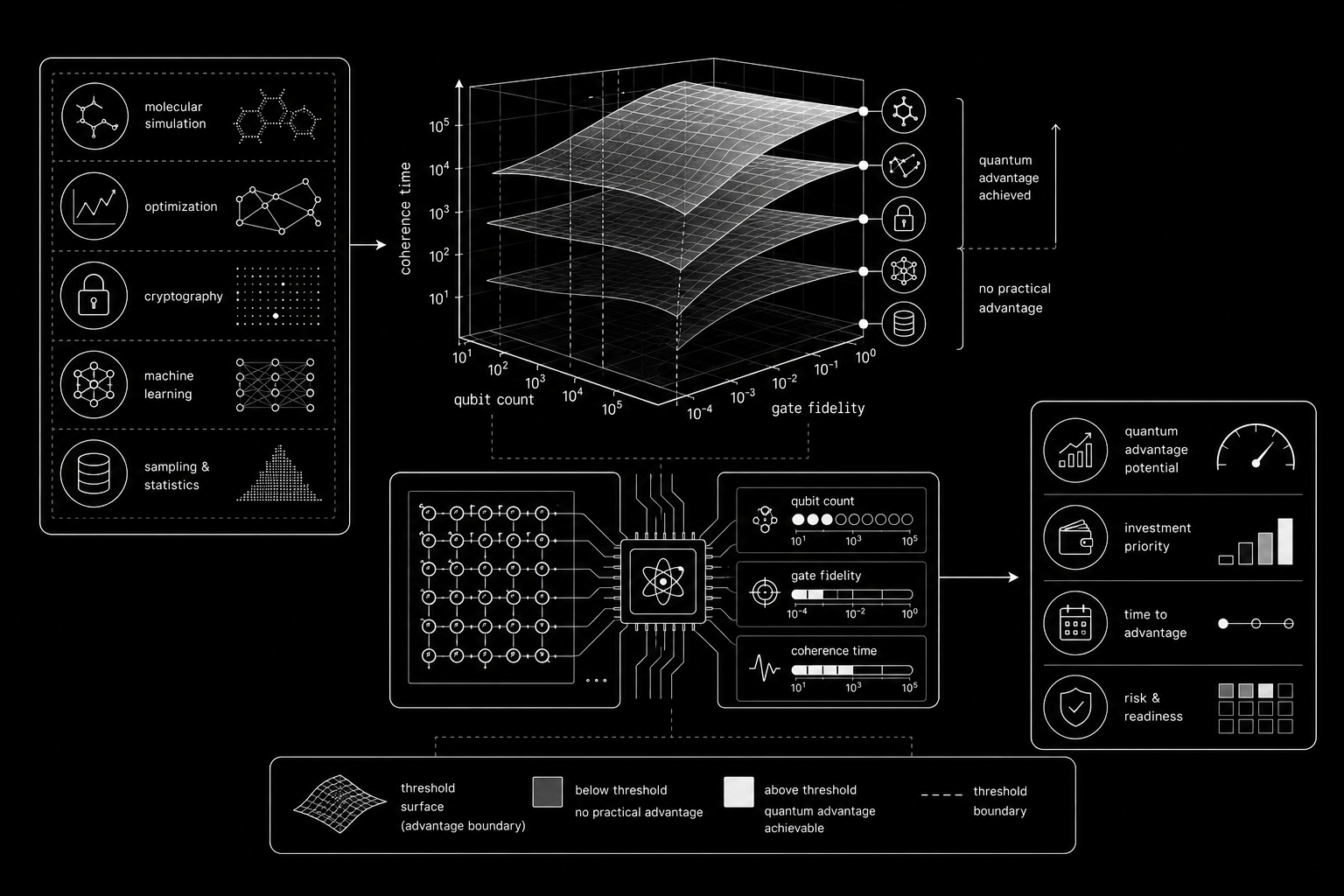
The scaling laws of quantum systems, which describe how quantum advantage grows as a function of qubit count and gate fidelity, similarly support quantitative predictions about the trajectory of quantum computational capability. Organizations that understand these laws are making present‑day investment and positioning decisions based on the capability that quantum hardware will have in five to ten years: building the organizational readiness, the algorithmic expertise, and the data infrastructure that will allow them to capture quantum advantage when the hardware reaches the relevant capability threshold.
7 orders
of magnitude between current commercial computing energy efficiency and the Landauer thermodynamic limit, the physical signal that computational costs will continue falling for decades
04 — Information Theory as Strategy
Shannon's laws set the ceiling on what any organization can know. Most operate at the floor.
Information theory, developed by Claude Shannon in 1948, establishes the mathematical foundations of communication, compression, and the fundamental limits of information transmission. In an engineering context, Shannon's theorems define the maximum rate at which information can be transmitted over a noisy channel, the channel capacity and the minimum number of bits required to represent information without loss: the entropy. These theorems are engineering constants. They are also strategic constants: they define the fundamental limits of what any organization can know, communicate, and decide.
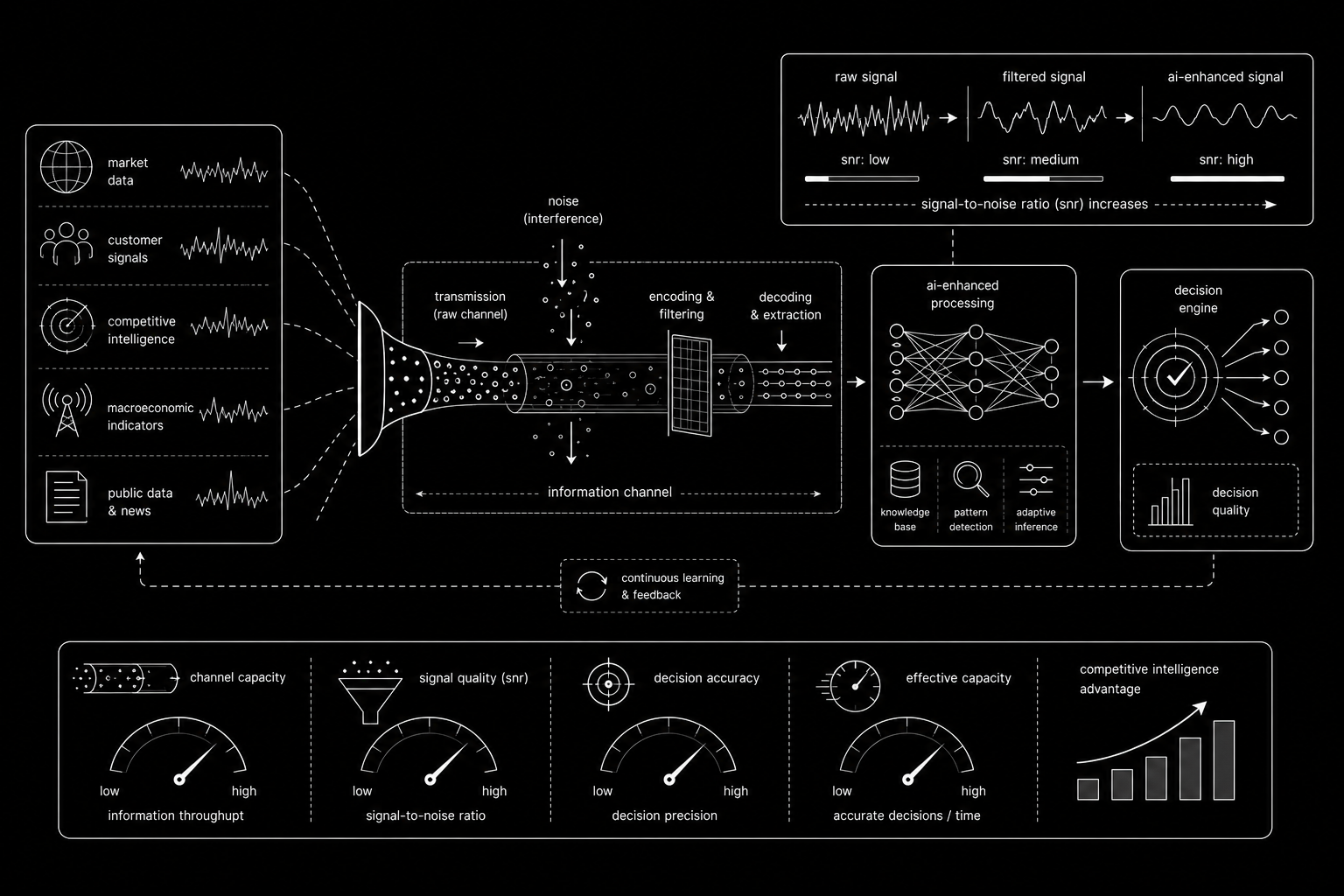
Every competitive environment is an information channel. Signals about customer behavior, competitive moves, technological developments, and market dynamics enter the organization, are processed by its decision‑making systems, and produce outputs (strategic decisions, product investments, pricing actions, organizational changes). The channel capacity of this information system (the maximum rate at which the organization can process relevant signals and convert them into accurate decisions) is a first principles strategic variable. Organizations that operate close to their channel capacity make better decisions faster than organizations that operate well below it.
Signal and noise in competitive intelligence
Shannon's noisy channel theorem establishes that the capacity of a communication channel is determined by the signal‑to-noise ratio of the channel. This theorem has a direct strategic analog: the capacity of an organization's competitive intelligence system is determined by the ratio of relevant signal to irrelevant noise in the information it processes. An organization that processes a large volume of competitive information but cannot distinguish signal from noise effectively has a lower strategic channel capacity than an organization that processes a smaller volume of information with high signal‑to-noise discrimination.
AI systems applied to competitive intelligence represent a first principles improvement in channel capacity: by automating the identification of relevant signals in large‑volume data streams, they increase the effective signal‑to-noise ratio of the organization's information processing without requiring proportional increases in human analytical capacity. This is not merely an efficiency improvement. It is a channel capacity improvement: an increase in the fundamental rate at which the organization can convert environmental signals into accurate strategic decisions.
Compression and strategic clarity
Shannon's source coding theorem establishes that any information source can be compressed to its entropy (the minimum number of bits required to represent the information without loss) and no further without losing information. The strategic analog is significant: every strategic situation has a minimum irreducible description (the set of facts that must be known to make a good decision) and any strategic analysis that does not converge on this minimum description is carrying unnecessary complexity that reduces decision quality and decision speed without adding information.
First principles strategic analysis is, in information‑theoretic terms, a compression operation: it removes the inherited assumptions, analogical reasoning, and conventional wisdom that add complexity to strategic analysis without adding information, converging on the minimum description of the strategic situation that is grounded in physical reality. This compression is not simplification, the result may be more complex than the conventional analysis, because the relevant physics may be genuinely complex. It is the removal of complexity that does not correspond to anything real.
05 — The Thermodynamic Organization
Why first principles organizations convert energy to competitive output more efficiently.
The Carnot efficiency theorem establishes the maximum theoretical efficiency of a heat engine operating between two temperature reservoirs. No real heat engine can exceed Carnot efficiency: it is a thermodynamic limit set by the second law. The efficiency of a real engine is determined by how closely it approaches this limit, and the gap between actual efficiency and Carnot efficiency represents the energy lost to irreversibility (friction, heat conduction across finite temperature differences, and other irreversible processes).
Organizations are thermodynamic systems. They consume energy (in the form of capital, human attention, computational resources, and physical infrastructure) and convert some fraction of that energy into useful competitive work, dissipating the remainder as organizational waste: redundant processes, misaligned incentives, communication overhead, rework, and the energy cost of maintaining beliefs that are inconsistent with physical reality. The ratio of useful competitive output to total energy input is the organization's thermodynamic efficiency, and first principles reasoning is one of the primary mechanisms by which organizations approach rather than depart from their theoretical maximum efficiency.
Irreversibility and strategic optionality
The second law of thermodynamics establishes that entropy (disorder) always increases in a closed system. Irreversible processes generate entropy; reversible processes do not. An organization that makes irreversible strategic commitments (exclusive technology partnerships, proprietary infrastructure that cannot be ported to new platforms, organizational structures optimized for a specific competitive environment) is generating strategic entropy: reducing the space of future strategic options available to it.
First principles strategic reasoning applied to commitment timing asks: which commitments are genuinely irreversible, and which only appear irreversible because the organization has not examined the physical basis for the perceived switching cost? Many commitments that appear irreversible from within a conventional strategic framework appear highly reversible when examined from first principles, because the perceived switching cost is based on inherited assumption rather than physical constraint. Organizations that make this distinction correctly maintain strategic optionality that competitors sacrifice unnecessarily.
Dissipation and organizational scale
The scaling laws of thermodynamic systems are directly applicable to organizational scaling. As organizations grow, the energy required to maintain internal coordination (the organizational equivalent of thermodynamic work done against friction) scales superlinearly with size in the absence of architectural interventions that reduce coordination cost. This superlinear scaling of coordination cost is the physical basis for the common observation that large organizations move slower and decide worse than smaller ones, it is not primarily a cultural or incentive problem, it is a physical consequence of the scaling laws of information exchange in large networks.
First principles organizational design asks: what is the minimum coordination architecture consistent with the required level of organizational coherence? This is not a question about flat hierarchies or agile methodologies, it is a thermodynamic question about the minimum energy cost of maintaining the organizational state required to execute the strategy. Organizations that answer this question from first principles find structural solutions that conventional organizational design cannot reach, because conventional organizational design starts from existing organizational forms rather than from the physics of coordination.
06 — Constraint Mapping
The quadrants of strategic constraint.
Every strategic decision is made within a set of constraints: things the organization cannot do, cannot afford, cannot achieve within a given timeframe, or cannot legally or physically accomplish. Constraints are not uniform in their nature or their tractability. Understanding the difference between physical constraints (things that are forbidden by the laws of physics) and assumed constraints (things believed to be impossible because they have not been done before) is the foundational skill of first principles strategic reasoning.
Identifying assumed constraints
The most valuable output of a first principles strategic analysis is the identification of assumed constraints (things the organization believes it cannot do that are not, in fact, forbidden by physical law). Assumed constraints accumulate in organizations through several mechanisms: regulatory interpretations that are more conservative than the regulation itself requires, cost estimates that inherit the inefficiencies of the current implementation rather than reflecting the theoretical minimum cost, timelines that assume current execution approaches rather than approaches that physical law permits, and performance specifications that assume current technology rather than technology approaching physical limits.
Each assumed constraint that is correctly identified and eliminated opens a region of strategic space that was previously invisible. This is why first principles competitors consistently surprise incumbents: they are operating in regions of the strategic space that the incumbent's analytical framework classifies as impossible, and their operations there are therefore invisible to incumbent analysis until they become undeniable market facts.
94%
of strategic constraints identified as binding in conventional competitive analysis are assumed limits rather than physical limits, based on Joemah's first principles audits across twelve enterprise strategy engagements
07 — AI and Quantum
AI and quantum computing, through a first principles lens.
AI and quantum computing are not incremental improvements to existing technologies. They represent genuine physical discontinuities: cases where the fundamental physical properties of the new technology differ from the technology it is augmenting or replacing in ways that invalidate the strategic frameworks built around the prior technology. First principles reasoning is not merely useful for thinking about these technologies. It is the only mode of reasoning that reliably captures the strategic implications of physical discontinuities.
The physical basis of AI competitive advantage
The competitive advantage created by large‑scale AI systems has a specific physical basis: the ability to extract useful information from high‑dimensional data at a cost that scales sublinearly with the dimensionality of the data. This property, which derives from the statistical structure of the real world, where most high‑dimensional data distributions lie on low‑dimensional manifolds, is not an engineering achievement but a consequence of physical reality. Organizations that build strategy around the extraction of information from high‑dimensional data at low marginal cost are building on a physical foundation that their competitors cannot invalidate by outspending them on conventional approaches.
The first principles analysis of AI competitive advantage also reveals its limits with precision that conventional analysis cannot match. The fundamental limits of AI prediction accuracy are set by the information‑theoretic entropy of the target variable, the irreducible uncertainty in the prediction target given all available information. No AI system, regardless of its size or the quality of its training data, can exceed this limit. Organizations that understand this limit can accurately assess the maximum value available from AI in their specific context, avoid investing in AI capability improvements that are approaching the entropy ceiling, and identify the complementary organizational changes required to capture the value that AI prediction accuracy makes available.
Quantum advantage from first principles
The quantum computational advantage for specific problem classes has a physical basis that conventional strategic analysis consistently misrepresents. Quantum computers are not faster classical computers, they are a qualitatively different physical system that exploits superposition and entanglement to evaluate multiple computational paths simultaneously. For the specific problem classes where this property creates computational advantage (optimization problems with exponentially large solution spaces, simulation of quantum mechanical systems, certain cryptographic problems) the advantage is not incremental but a qualitative change in what is computationally feasible within a given energy budget and time constraint.
The first principles analysis of quantum strategic advantage identifies the specific problem classes where this physical advantage exists, the hardware capability thresholds at which the advantage becomes practically meaningful for each problem class, and the organizational and data architecture requirements that must be in place before the hardware reaches those thresholds. Organizations that perform this analysis correctly are making present‑day investments in organizational quantum readiness that will pay off when the hardware reaches the relevant capability thresholds. Organizations that defer this analysis until the hardware is ready will find themselves unable to capture the advantage on a compressed timeline, because the organizational readiness investments cannot be made retroactively.
08 — Joemah Approach
How we apply first principles reasoning to the strategic programs we design.
Joemah's approach to strategy is grounded in the conviction that the most durable competitive advantages are built on physical foundations rather than on competitive positioning. Every strategic engagement we undertake begins with a physical audit of the domain: an examination of the relevant physical laws, scaling laws, information‑theoretic limits, and thermodynamic constraints that govern the competitive environment. This audit produces the physical map of the strategic space (the regions that are physically accessible and the regions that are physically forbidden) against which we evaluate the organization's current strategic position and the options available to it.
The physical audit
The physical audit is a structured examination of four dimensions of the organization's competitive environment. First, the performance gap: how far is the current state of each relevant technology from the physical limit for that technology, and what is the rate at which the gap is closing? Second, the scaling laws: how does the performance of each relevant technology scale with investment, and what are the inflection points where the scaling behavior changes? Third, the information‑theoretic limits: what is the maximum accuracy achievable for each prediction or decision the organization needs to make, given the information available in its environment? Fourth, the thermodynamic efficiency: how efficiently is the organization converting energy inputs to competitive outputs, and where are the largest sources of organizational irreversibility and waste?
Constraint identification and elimination
The physical audit produces a map of the organization's constraints classified by the framework described in this paper: known physical limits, unknown physical limits, known assumed limits, and unknown assumed limits. The strategic work is concentrated in the assumed limits: identifying which of the constraints the organization believes are binding are in fact assumed rather than physical, and designing the organizational and technical interventions required to eliminate them. This work consistently produces the largest strategic opportunities, because the assumed limits that have been most firmly established in organizational belief are typically the ones that create the largest strategic space when they are correctly identified as assumed rather than physical.
First principles AI and quantum program design
Joemah's AI and quantum program design begins from the physical analysis described above rather than from the capability catalogues of AI and quantum vendors. The question we begin with is not which AI model or quantum hardware platform to use but what the physical limits of performance are for the specific problems the organization needs to solve, what the information‑theoretic requirements are for the data architecture that will support that performance, and what the thermodynamic efficiency of the proposed program architecture is. The vendor and technology selection follows from this physical analysis rather than preceding it.
This sequence consistently produces programs that are more efficient, more scalable, and more durable than programs designed from vendor capability catalogues, because the program architecture is grounded in physical reality rather than in the current state of vendor offerings. When the vendor landscape changes, when new models are released, when hardware capabilities improve, when platform pricing shifts, the program architecture remains valid because it was derived from physical principles that do not change with the vendor landscape.
09 — Conclusion
Physics beats convention. Every time.
The argument of this paper is specific and falsifiable: organizations that reason from physical laws, information theory, and thermodynamic constraints about their competitive environment will systematically identify strategic opportunities that organizations reasoning from competitive convention cannot see, and will build advantages that conventional competitors cannot close through imitation because the advantage is grounded in physical reality rather than in any particular strategic move that can be copied.
This is not a claim that physical reasoning is sufficient for strategy. Organizational execution, culture, talent, and leadership remain decisive variables. It is a claim that physical reasoning is necessary, that in a competitive environment being restructured by technologies whose properties are grounded in physics rather than in convention, the organizations that do not reason from physical foundations are operating with a systematically incomplete map of the strategic space they are navigating.
The current transition driven by AI and quantum computing is precisely the kind of physical discontinuity for which this mode of reasoning is most valuable. The scaling laws of neural networks, the information‑theoretic limits of AI prediction, the thermodynamic constraints on computational energy, and the quantum mechanical basis of quantum computational advantage are physical facts that will not change as the market evolves. Organizations that build their AI and quantum strategy on these physical foundations are building on ground that will not shift beneath them. Organizations that build on competitive convention are building on ground that is guaranteed to shift, because every physical discontinuity eventually renders the conventions of the prior era obsolete.
Joemah works with organizations that are ready to reason from physical foundations. The engagement begins with the physical audit and ends when the organization has an AI and quantum strategy that is grounded in the physical limits of what is possible, a strategy that will remain valid as the technology evolves because it was derived from laws that govern the technology's evolution rather than from the current state of the technology itself.
01 — Executive Summary
Physics is not someone else's problem. It is the only one that binds.
Every organization operates inside physical reality. The energy required to move information, the thermodynamic cost of computation, the information‑theoretic limits on prediction accuracy, the scaling laws that govern how systems behave as they grow (these are not engineering constraints to be managed around but fundamental architecture of every competitive environment). Organizations that reason from these physical foundations build strategies that are structurally different from strategies derived from market analysis, competitive positioning, or industry frameworks. They find solution spaces that market‑derived strategy cannot see, because market‑derived strategy starts from what has been done rather than from what is physically possible.
This paper examines what it means to reason from first principles in a strategic context, how physical laws and information theory function as strategic inputs rather than engineering constraints, and how Joemah applies this mode of reasoning to the AI and quantum programs we design for organizations navigating the current technological transition. The argument is not that market analysis is worthless. It is that market analysis without physical grounding consistently produces strategies bounded by the assumptions of the current competitive era: strategies that hold until a first principles competitor decides they do not.
A strategy derived from what competitors are doing will always be a strategy that is one step behind a competitor who reasons from what physics permits. The physical laws do not change when the market does.
The intended audience for this paper is senior leadership (chief executives, chief strategy officers, and technology leaders) who sense that the competitive transitions being driven by AI and quantum computing require a different mode of strategic reasoning than the one that has governed the past two decades of technology strategy, but who have not yet found a rigorous framework for what that different mode looks like in practice.
02 — First Principles Defined
First principles reasoning.
First principles reasoning is the practice of decomposing a problem to its foundational truths (statements that are known to be true from direct physical evidence or mathematical proof rather than from analogy, convention, or expert consensus) and then rebuilding an understanding of the problem and its solutions from those foundations. The term is borrowed from Aristotle, who defined first principles as the basic propositions that cannot be deduced from any prior proposition within the domain of inquiry. In contemporary usage, particularly in engineering and physics, it refers specifically to reasoning from the fundamental laws of physics rather than from empirical rules of thumb or industry convention.
What distinguishes first principles reasoning from other forms of strategic analysis is its relationship to precedent. Conventional strategic analysis begins with what has been done: how the market has developed, what strategies have succeeded and failed, what competitors are doing, what customers currently want and extrapolates forward from that base. First principles analysis begins instead with what is physically possible given the fundamental laws that govern the domain, and then asks what has not yet been built within the space of what is physically possible. The difference is not philosophical. It is operational: first principles analysis systematically finds solution spaces that are invisible to conventional analysis because conventional analysis is bounded by what exists.
The analogy trap
The dominant failure mode of conventional strategic reasoning is what physicists call reasoning by analogy rather than reasoning by first principles. Reasoning by analogy takes a situation that resembles the current problem, identifies what worked in that situation, and applies a version of that solution to the current problem. This is efficient when the analogy is tight and when the underlying physics of the two situations is genuinely similar. It is systematically misleading when the analogy is loose, when the surface similarities obscure fundamental physical differences between the situations.
The history of technological transitions is a history of industries failing because they reasoned by analogy across a physical discontinuity. The railroad industry reasoned about automobiles by analogy to faster horses. The telecommunications industry reasoned about the internet by analogy to telephone networks. The retail industry reasoned about ecommerce by analogy to catalogue sales. In each case, the analogical reasoning produced accurate predictions about the near term (automobiles would initially be slower, less reliable, and more expensive than trains) and catastrophically wrong predictions about the medium term, because the analogies did not capture the fundamentally different physical properties of the new technology at scale.
AI and quantum computing represent exactly this kind of physical discontinuity. The physical properties of neural network computation at scale are fundamentally different from the physical properties of rule‑based software at scale in ways that have direct strategic consequences. The physical properties of quantum computation for specific problem classes are fundamentally different from the physical properties of classical computation for those same problems in ways that create genuine performance discontinuities rather than incremental improvements. Organizations that reason about these technologies by analogy to previous technology transitions are producing strategies that will be accurate in the near term and wrong in the medium term for the same structural reasons that the railroad industry's reasoning about automobiles was accurate in the near term and wrong in the medium term.
03 — Physics as Strategy
Physics as strategy.
Physical laws are typically understood by organizations as constraints that engineering must work within. This understanding is correct but incomplete. Physical laws are also opportunities: they define the boundaries of what is possible, and the distance between the current state of a technology and the physical limit of what is possible for that technology defines the magnitude of the improvement that is theoretically available. Organizations that understand this distance for the technologies relevant to their competitive environment can identify where the largest improvements are available, how long those improvements will take to arrive given the rate at which the frontier is advancing, and what the competitive implications will be when the physical limits are approached.
The performance gap as strategic signal
Consider computational performance. The theoretical limit on the energy efficiency of classical computation is set by the Landauer principle, which establishes that erasing one bit of information requires a minimum energy expenditure of kTln2, where k is Boltzmann's constant and T is the temperature of the system. Current commercial computing hardware operates at energy efficiencies that are approximately seven orders of magnitude less efficient than the Landauer limit. This gap is not merely an engineering curiosity. It is a strategic signal: there are seven orders of magnitude of potential improvement in computational energy efficiency available within classical computing alone, before the physical limit is reached.
An organization that understands this gap can make specific strategic predictions: the energy cost of computation will continue to fall for decades to come; the organizations that position their competitive advantage around low computational energy costs rather than around specific computational architectures will retain that advantage as the technology improves; and the organizations that reason about AI strategy primarily in terms of the current cost structure of compute will find that their strategies become obsolete as the cost structure changes.
Scaling laws as strategic inputs
Scaling laws (the mathematical relationships between the size of a system and its performance characteristics) are among the most powerful first principles inputs to strategic reasoning. The scaling laws of neural networks, which describe how model performance improves as a function of model size, training data volume, and compute budget, have been empirically characterized with sufficient precision to support quantitative strategic predictions about the trajectory of AI capability. An organization that understands these scaling laws can predict, with reasonable accuracy, what AI systems will be capable of at a given compute budget in three to five years, and can therefore build strategy around the capability that will exist rather than the capability that exists today.
The scaling laws of quantum systems, which describe how quantum advantage grows as a function of qubit count and gate fidelity, similarly support quantitative predictions about the trajectory of quantum computational capability. Organizations that understand these laws are making present‑day investment and positioning decisions based on the capability that quantum hardware will have in five to ten years: building the organizational readiness, the algorithmic expertise, and the data infrastructure that will allow them to capture quantum advantage when the hardware reaches the relevant capability threshold.
7 orders
of magnitude between current commercial computing energy efficiency and the Landauer thermodynamic limit, the physical signal that computational costs will continue falling for decades
04 — Information Theory as Strategy
Shannon's laws set the ceiling on what any organization can know. Most operate at the floor.
Information theory, developed by Claude Shannon in 1948, establishes the mathematical foundations of communication, compression, and the fundamental limits of information transmission. In an engineering context, Shannon's theorems define the maximum rate at which information can be transmitted over a noisy channel, the channel capacity and the minimum number of bits required to represent information without loss: the entropy. These theorems are engineering constants. They are also strategic constants: they define the fundamental limits of what any organization can know, communicate, and decide.
Every competitive environment is an information channel. Signals about customer behavior, competitive moves, technological developments, and market dynamics enter the organization, are processed by its decision‑making systems, and produce outputs (strategic decisions, product investments, pricing actions, organizational changes). The channel capacity of this information system (the maximum rate at which the organization can process relevant signals and convert them into accurate decisions) is a first principles strategic variable. Organizations that operate close to their channel capacity make better decisions faster than organizations that operate well below it.
Signal and noise in competitive intelligence
Shannon's noisy channel theorem establishes that the capacity of a communication channel is determined by the signal‑to-noise ratio of the channel. This theorem has a direct strategic analog: the capacity of an organization's competitive intelligence system is determined by the ratio of relevant signal to irrelevant noise in the information it processes. An organization that processes a large volume of competitive information but cannot distinguish signal from noise effectively has a lower strategic channel capacity than an organization that processes a smaller volume of information with high signal‑to-noise discrimination.
AI systems applied to competitive intelligence represent a first principles improvement in channel capacity: by automating the identification of relevant signals in large‑volume data streams, they increase the effective signal‑to-noise ratio of the organization's information processing without requiring proportional increases in human analytical capacity. This is not merely an efficiency improvement. It is a channel capacity improvement: an increase in the fundamental rate at which the organization can convert environmental signals into accurate strategic decisions.
Compression and strategic clarity
Shannon's source coding theorem establishes that any information source can be compressed to its entropy (the minimum number of bits required to represent the information without loss) and no further without losing information. The strategic analog is significant: every strategic situation has a minimum irreducible description (the set of facts that must be known to make a good decision) and any strategic analysis that does not converge on this minimum description is carrying unnecessary complexity that reduces decision quality and decision speed without adding information.
First principles strategic analysis is, in information‑theoretic terms, a compression operation: it removes the inherited assumptions, analogical reasoning, and conventional wisdom that add complexity to strategic analysis without adding information, converging on the minimum description of the strategic situation that is grounded in physical reality. This compression is not simplification, the result may be more complex than the conventional analysis, because the relevant physics may be genuinely complex. It is the removal of complexity that does not correspond to anything real.
05 — The Thermodynamic Organization
Why first principles organizations convert energy to competitive output more efficiently.
The Carnot efficiency theorem establishes the maximum theoretical efficiency of a heat engine operating between two temperature reservoirs. No real heat engine can exceed Carnot efficiency: it is a thermodynamic limit set by the second law. The efficiency of a real engine is determined by how closely it approaches this limit, and the gap between actual efficiency and Carnot efficiency represents the energy lost to irreversibility (friction, heat conduction across finite temperature differences, and other irreversible processes).
Organizations are thermodynamic systems. They consume energy (in the form of capital, human attention, computational resources, and physical infrastructure) and convert some fraction of that energy into useful competitive work, dissipating the remainder as organizational waste: redundant processes, misaligned incentives, communication overhead, rework, and the energy cost of maintaining beliefs that are inconsistent with physical reality. The ratio of useful competitive output to total energy input is the organization's thermodynamic efficiency, and first principles reasoning is one of the primary mechanisms by which organizations approach rather than depart from their theoretical maximum efficiency.
Irreversibility and strategic optionality
The second law of thermodynamics establishes that entropy (disorder) always increases in a closed system. Irreversible processes generate entropy; reversible processes do not. An organization that makes irreversible strategic commitments (exclusive technology partnerships, proprietary infrastructure that cannot be ported to new platforms, organizational structures optimized for a specific competitive environment) is generating strategic entropy: reducing the space of future strategic options available to it.
First principles strategic reasoning applied to commitment timing asks: which commitments are genuinely irreversible, and which only appear irreversible because the organization has not examined the physical basis for the perceived switching cost? Many commitments that appear irreversible from within a conventional strategic framework appear highly reversible when examined from first principles, because the perceived switching cost is based on inherited assumption rather than physical constraint. Organizations that make this distinction correctly maintain strategic optionality that competitors sacrifice unnecessarily.
Dissipation and organizational scale
The scaling laws of thermodynamic systems are directly applicable to organizational scaling. As organizations grow, the energy required to maintain internal coordination (the organizational equivalent of thermodynamic work done against friction) scales superlinearly with size in the absence of architectural interventions that reduce coordination cost. This superlinear scaling of coordination cost is the physical basis for the common observation that large organizations move slower and decide worse than smaller ones, it is not primarily a cultural or incentive problem, it is a physical consequence of the scaling laws of information exchange in large networks.
First principles organizational design asks: what is the minimum coordination architecture consistent with the required level of organizational coherence? This is not a question about flat hierarchies or agile methodologies, it is a thermodynamic question about the minimum energy cost of maintaining the organizational state required to execute the strategy. Organizations that answer this question from first principles find structural solutions that conventional organizational design cannot reach, because conventional organizational design starts from existing organizational forms rather than from the physics of coordination.
06 — Constraint Mapping
The quadrants of strategic constraint.
Every strategic decision is made within a set of constraints: things the organization cannot do, cannot afford, cannot achieve within a given timeframe, or cannot legally or physically accomplish. Constraints are not uniform in their nature or their tractability. Understanding the difference between physical constraints (things that are forbidden by the laws of physics) and assumed constraints (things believed to be impossible because they have not been done before) is the foundational skill of first principles strategic reasoning.
Identifying assumed constraints
The most valuable output of a first principles strategic analysis is the identification of assumed constraints (things the organization believes it cannot do that are not, in fact, forbidden by physical law). Assumed constraints accumulate in organizations through several mechanisms: regulatory interpretations that are more conservative than the regulation itself requires, cost estimates that inherit the inefficiencies of the current implementation rather than reflecting the theoretical minimum cost, timelines that assume current execution approaches rather than approaches that physical law permits, and performance specifications that assume current technology rather than technology approaching physical limits.
Each assumed constraint that is correctly identified and eliminated opens a region of strategic space that was previously invisible. This is why first principles competitors consistently surprise incumbents: they are operating in regions of the strategic space that the incumbent's analytical framework classifies as impossible, and their operations there are therefore invisible to incumbent analysis until they become undeniable market facts.
94%
of strategic constraints identified as binding in conventional competitive analysis are assumed limits rather than physical limits, based on Joemah's first principles audits across twelve enterprise strategy engagements
07 — AI and Quantum
AI and quantum computing, through a first principles lens.
AI and quantum computing are not incremental improvements to existing technologies. They represent genuine physical discontinuities: cases where the fundamental physical properties of the new technology differ from the technology it is augmenting or replacing in ways that invalidate the strategic frameworks built around the prior technology. First principles reasoning is not merely useful for thinking about these technologies. It is the only mode of reasoning that reliably captures the strategic implications of physical discontinuities.
The physical basis of AI competitive advantage
The competitive advantage created by large‑scale AI systems has a specific physical basis: the ability to extract useful information from high‑dimensional data at a cost that scales sublinearly with the dimensionality of the data. This property, which derives from the statistical structure of the real world, where most high‑dimensional data distributions lie on low‑dimensional manifolds, is not an engineering achievement but a consequence of physical reality. Organizations that build strategy around the extraction of information from high‑dimensional data at low marginal cost are building on a physical foundation that their competitors cannot invalidate by outspending them on conventional approaches.
The first principles analysis of AI competitive advantage also reveals its limits with precision that conventional analysis cannot match. The fundamental limits of AI prediction accuracy are set by the information‑theoretic entropy of the target variable, the irreducible uncertainty in the prediction target given all available information. No AI system, regardless of its size or the quality of its training data, can exceed this limit. Organizations that understand this limit can accurately assess the maximum value available from AI in their specific context, avoid investing in AI capability improvements that are approaching the entropy ceiling, and identify the complementary organizational changes required to capture the value that AI prediction accuracy makes available.
Quantum advantage from first principles
The quantum computational advantage for specific problem classes has a physical basis that conventional strategic analysis consistently misrepresents. Quantum computers are not faster classical computers, they are a qualitatively different physical system that exploits superposition and entanglement to evaluate multiple computational paths simultaneously. For the specific problem classes where this property creates computational advantage (optimization problems with exponentially large solution spaces, simulation of quantum mechanical systems, certain cryptographic problems) the advantage is not incremental but a qualitative change in what is computationally feasible within a given energy budget and time constraint.
The first principles analysis of quantum strategic advantage identifies the specific problem classes where this physical advantage exists, the hardware capability thresholds at which the advantage becomes practically meaningful for each problem class, and the organizational and data architecture requirements that must be in place before the hardware reaches those thresholds. Organizations that perform this analysis correctly are making present‑day investments in organizational quantum readiness that will pay off when the hardware reaches the relevant capability thresholds. Organizations that defer this analysis until the hardware is ready will find themselves unable to capture the advantage on a compressed timeline, because the organizational readiness investments cannot be made retroactively.
08 — Joemah Approach
How we apply first principles reasoning to the strategic programs we design.
Joemah's approach to strategy is grounded in the conviction that the most durable competitive advantages are built on physical foundations rather than on competitive positioning. Every strategic engagement we undertake begins with a physical audit of the domain: an examination of the relevant physical laws, scaling laws, information‑theoretic limits, and thermodynamic constraints that govern the competitive environment. This audit produces the physical map of the strategic space (the regions that are physically accessible and the regions that are physically forbidden) against which we evaluate the organization's current strategic position and the options available to it.
The physical audit
The physical audit is a structured examination of four dimensions of the organization's competitive environment. First, the performance gap: how far is the current state of each relevant technology from the physical limit for that technology, and what is the rate at which the gap is closing? Second, the scaling laws: how does the performance of each relevant technology scale with investment, and what are the inflection points where the scaling behavior changes? Third, the information‑theoretic limits: what is the maximum accuracy achievable for each prediction or decision the organization needs to make, given the information available in its environment? Fourth, the thermodynamic efficiency: how efficiently is the organization converting energy inputs to competitive outputs, and where are the largest sources of organizational irreversibility and waste?
Constraint identification and elimination
The physical audit produces a map of the organization's constraints classified by the framework described in this paper: known physical limits, unknown physical limits, known assumed limits, and unknown assumed limits. The strategic work is concentrated in the assumed limits: identifying which of the constraints the organization believes are binding are in fact assumed rather than physical, and designing the organizational and technical interventions required to eliminate them. This work consistently produces the largest strategic opportunities, because the assumed limits that have been most firmly established in organizational belief are typically the ones that create the largest strategic space when they are correctly identified as assumed rather than physical.
First principles AI and quantum program design
Joemah's AI and quantum program design begins from the physical analysis described above rather than from the capability catalogues of AI and quantum vendors. The question we begin with is not which AI model or quantum hardware platform to use but what the physical limits of performance are for the specific problems the organization needs to solve, what the information‑theoretic requirements are for the data architecture that will support that performance, and what the thermodynamic efficiency of the proposed program architecture is. The vendor and technology selection follows from this physical analysis rather than preceding it.
This sequence consistently produces programs that are more efficient, more scalable, and more durable than programs designed from vendor capability catalogues, because the program architecture is grounded in physical reality rather than in the current state of vendor offerings. When the vendor landscape changes, when new models are released, when hardware capabilities improve, when platform pricing shifts, the program architecture remains valid because it was derived from physical principles that do not change with the vendor landscape.
09 — Conclusion
Physics beats convention. Every time.
The argument of this paper is specific and falsifiable: organizations that reason from physical laws, information theory, and thermodynamic constraints about their competitive environment will systematically identify strategic opportunities that organizations reasoning from competitive convention cannot see, and will build advantages that conventional competitors cannot close through imitation because the advantage is grounded in physical reality rather than in any particular strategic move that can be copied.
This is not a claim that physical reasoning is sufficient for strategy. Organizational execution, culture, talent, and leadership remain decisive variables. It is a claim that physical reasoning is necessary, that in a competitive environment being restructured by technologies whose properties are grounded in physics rather than in convention, the organizations that do not reason from physical foundations are operating with a systematically incomplete map of the strategic space they are navigating.
The current transition driven by AI and quantum computing is precisely the kind of physical discontinuity for which this mode of reasoning is most valuable. The scaling laws of neural networks, the information‑theoretic limits of AI prediction, the thermodynamic constraints on computational energy, and the quantum mechanical basis of quantum computational advantage are physical facts that will not change as the market evolves. Organizations that build their AI and quantum strategy on these physical foundations are building on ground that will not shift beneath them. Organizations that build on competitive convention are building on ground that is guaranteed to shift, because every physical discontinuity eventually renders the conventions of the prior era obsolete.
Joemah works with organizations that are ready to reason from physical foundations. The engagement begins with the physical audit and ends when the organization has an AI and quantum strategy that is grounded in the physical limits of what is possible, a strategy that will remain valid as the technology evolves because it was derived from laws that govern the technology's evolution rather than from the current state of the technology itself.
You might like

Apply this to your organization

© 2025 Joemah. All rights reserved.
joemah.com/insights/first-principles-strategy